Highlights from the Baltic Family Business Conference 2026
The 4th BFFI - ECGI Conference, "Steering the Legacy: Governance and Succession in Family Enterprises," was held at the Estonian Business School, Tallinn, June 15-16, 2026. The event featured 50+ expert speakers and gathered more than 150 participants from 18 countries.
Conference Organizers


General Sponsor

Partners and Supporters


Citizen Investors
Luigi Zingales (University of Chicago, Booth School of Business) challenged the traditional economic doctrine that corporations must focus solely on maximizing shareholder value while leaving social and ethical issues entirely to governments. Analyzing historical shareholder resolutions, such as those targeting antibiotic use in food supply chains, he argued that Milton Friedman's separation of economic and social goals fails in the presence of inseparable negative externalities like pollution or public health risks. Instead, he posited that firms should strive to maximize shareholder welfare rather than raw shareholder value. To overcome investor apathy and efficiently aggregate diverse ethical preferences, he proposed introducing "sortition" – the random selection of a small, representative panel of investors to deliberate on and establish moral guidelines for corporate behavior. Backed by real-world precedents from major pension funds, this deliberative model offers a legitimate, politically neutral, and economically feasible alternative to traditional proxy voting.
Luigi Zingales
University of Chicago, Booth School of Business

Family Values
Renée Adams (University of Oxford) examined the empirical relationship between the sociopolitical rhetoric surrounding traditional "family values" and the actual behavior of family-owned business boards. Drawing on comprehensive survey data from Sweden, Turkey, and the European Social Survey, she assessed how personal values, gender, and family ownership structures interact to influence corporate decision-making. Her findings challenged popular assumptions: family firm directors do not empirically embody traditional, conservation-oriented family values, nor are family firms naturally more stakeholder-oriented than their peers. Notably, female directors within family businesses often demonstrate a stronger alignment with pro-shareholder interests than non-family female directors. Adams concluded that relying on traditional family stereotypes can crowd out diversity of thought, emphasizing instead the importance of evidence-based selection and modern value alignment over legacy domestic ideals in corporate governance.
Renée Adams
University of Oxford

To Become and to Be the One We Are: Social Stewardship for Six Generations
Erik Stern (Board Member at Ragnar Söderbergs foundation; Deputy Director at FBN Sweden (G6)) shared the multigenerational journey of the Söderberg family and their investment company, Ratos, illustrating how long-term social stewardship can sustain a business system across six generations. Tracking the firm's evolution from a 19th-century iron wholesaler to a multi-billion-euro modern investment group, Stern highlighted the delicate integration of family, ownership, and business. A central pillar of their governance model is the preservation of voting power through family foundations dedicated to funding national scientific research in economics, medicine, and law. This structural separation of personal wealth from capital deployment reflects a foundational family belief: that capital must be managed as a societal resource within the broader economic cycle. Stern demonstrated that a family enterprise's enduring success relies on continuous, value-driven stewardship that treats capital preservation and social contribution as mutually reinforcing goals.
Erik Stern
Board Member at Ragnar Söderbergs foundation; Deputy Director at FBN Sweden (G6)

From Heritage to High Performance... and Back!
Markus Wartiovaara explored the multi-dimensional nature of "high performance" within family-owned enterprises, using the operational history of Finnish machinery distributor Rotator and parent group Captum as a case study. He argued that true success in a family business cannot be measured solely by traditional financial KPIs like growth and EBIT. Instead, organizations must equally monitor ownership performance (alignment, governance, and capital allocation) and family performance (trust, conflict health, next-generation development, and shared identity). Wartiovaara introduced a holistic leadership framework centered on four dimensions of connection – self, others, system, and transformation – while emphasizing the critical role of continuous education in preventing governance stagnation. By aligning corporate efficiency with the "Nordic happiness advantage" and psychological resilience, he illustrated how legacy businesses can successfully transition between high-performance operational phases and values-driven family heritage
Markus Wartiovaara
Chairman of the Board of Rotator Oy, Finland (G3)
Practitioner Workshops (Part 1)
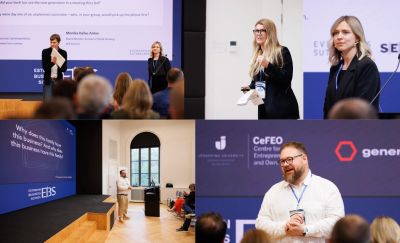
Family Enterprise Property and Succession: Lessons from Banking and Legal Practice
Anete Marhele (Eversheds Sutherland Bitāns) and Monika Kallas-Anton (SEB Estonia) provided a lawyer’s and banker’s look at the critical intersections of property, financing, and succession planning. Together, they explained how everyday structural choices – such as holding real estate personally or operating on undocumented leases – frequently function as hidden succession decisions. The keynote also provided a roadmap designed to guide families through the immediate shock of unplanned succession triggers like sudden illness or divorce. By introducing a 12-question diagnostic checklist, the speakers encouraged families to align ownership, control, and risk proactively to secure long-term bankability and prevent destructive operational paralysis.
Family Enterprise Education: Architecting Family Stewardship
Massimo Baù (Jönköping International Business School) addressed the critical gap between business investment and owner development, arguing that family enterprise education is an ongoing, vital responsibility rather than an occasional event. He observed that traditional corporate education often favors comfortable topics like finance and strategy while neglecting the core pillars of trust, shared values, and conflict resolution. By presenting a framework built around four competence domains (Enterprise, Ownership, Family, and Self), Baù illustrated how families can cultivate "psychological ownership" to transition individuals from passive beneficiaries to active stewards. The session provided a diagnostic, context-specific design model, coupled with a six-step circular implementation process to help families integrate structured and age-appropriate learning into their daily business.
Practitioner Workshops (Part 2)
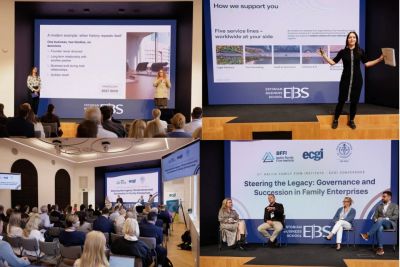
Prepare Your Business for Generational Change: Why Postponement is the Most Expensive Decision
Jurgita Karvelė and Hanna Esko (Sorainen) delivered a historical and modern analysis of inheritance disputes, illustrating why delaying succession planning remains a highly costly corporate decision. They detailed how common psychological barriers, such as assuming that it is too early or the desire to avoid immediate conflict, regularly expose families to costly litigation, frozen assets, and severe tax liabilities. Through a contemporary case study of an unresolved estate involving multiple family branches and a sudden death, the speakers demonstrated how quickly operational value can collapse without clear, founder-led decisions. The speakers concluded by outlining a practical pre-mortem toolkit – covering marital asset regimes, strategic gifting, and emergency fund planning – to help owners protect business continuity before a crisis occurs.
Lessons from the Baltic Frontline: A Real-World Case Study on Governance & Succession
Kristiina Reinson (RÖDL Estonia) shared a practical case study of a multinational family enterprise facing a common generational gap: an active founder wishing to retain operational control while the next generation is still too young to take over. Using a complex, multi-jurisdictional starting point, Reinson evaluated the "Stiftung" (German family foundation) as a robust governance mechanism designed to prevent asset fragmentation and safeguard generational wealth. While analyzing the structural tax benefits and continuity advantages of the Stiftung model, she also addressed the primary founder concern of losing immediate control. The session demonstrated how assets can be strategically restructured to allow founders to remain operationally active while preserving the foundation model as a secure, long-term pathway for future succession.
Practitioner Workshops (Part 3)
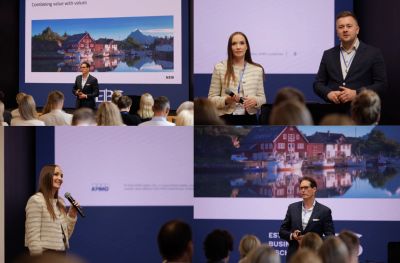
When Family Dynamics Meet Business Risk: Governance That Protects Value
KPMG Latvia presented a structured methodology for identifying, measuring, and mitigating the business risks that stem from family dynamics. The session framed relationship issues, such as poor communication, unclear roles, and low trust, as quantifiable threats to enterprise value, leading to decision paralysis and weak operational accountability. By integrating these interpersonal dynamics directly into a corporate risk register, the presenters outlined practical governance responses to manage issues like founder dependency and entitlement risk. To protect long-term assets, the workshop highlighted five essential protective tools: a decision-rights map, an emergency succession plan, a family employment policy, a conflict escalation protocol, and a risk appetite statement.
Stewardship Over Performance: Governing for Sustainable, Multi-generational Growth
Paal Even Karstensen (SEB) explored how family-owned enterprises can achieve sustainable, multi-generational growth by prioritizing long-term stewardship over short-term performance metrics. Presenting empirical data showing that family-controlled businesses consistently outpace their peers in revenue growth and cash flow return, Karstensen highlighted the strategic benefit of conservative leverage and patient capital. He introduced the structural concepts of investment holding companies, family offices, and foundations as essential vehicles for managing the transition of ownership across generations. Using the 160-year-old Swedish Wallenberg ecosystem as a benchmark, the session illustrated how a structured, foundation-led ownership model can successfully recycle dividends into research and education while preserving corporate control and national competitiveness.
Academic Track
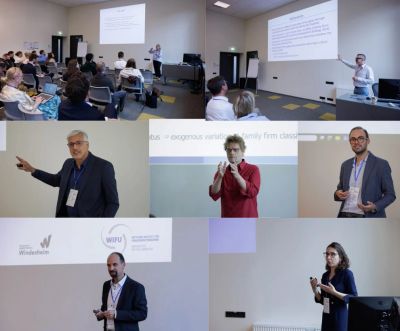
Paper 1 | Legacy Creation in Modern Business Families: Patchwork and Multi-Parent Constellations
Presenter: Tobias Köllner (WIFU) | Discussant: Beata Żukowska (Maria Curie-Skłodowska University in Lublin)
The paper presented by Tobias Köllner (WIFU) explores how non-traditional family structures, specifically LGBTQ+ multi-parent and patchwork constellations, construct and transfer legacy. Focusing on a multi-generational hotel and restaurant in the Netherlands, the co-author shows how kinship and "familiness" are actively built through social and intentional practices rather than biological links. To maintain family cohesion and operational continuity, these families use unique informal governance tools such as co-parenting agreements and "pedagogical deep dive evenings". The discussant praised the paper's expansion of the family embeddedness perspective but raised important questions regarding the transferability of these informal governance innovations, the potential for successor identity conflict in multi-parent households, and the unique relational hurdles LGBTQ+ family firms face during internationalisation.
Paper 2 | The Talent Gap in Family Firms
Presenter: Morten Bennedsen (University of Copenhagen) | Discussant: Benjamin Maury (Hanken School of Economics)
Do family firms employ less measured cognitive talent than their non-family counterparts? Morten Bennedsen (University of Copenhagen) presented a paper investigating this complex issue using comprehensive Danish administrative and military-draft IQ data. The study uncovers a substantial "talent gap" in family firms, with employees scoring lower on average – a gap that becomes most pronounced at the top executive and managerial levels. The co-author identifies two primary drivers of this deficit: a nepotism effect where family members are promoted beyond their objective qualifications (thereby blocking high-ability outsiders), and a compensation penalty that makes family firms less competitive when bidding for top-tier talent. The discussant commended the study’s data-driven approach and its focus on dual internal labor markets, while suggesting that the authors more clearly connect this cognitive talent gap to firm productivity and evaluate its sensitivity to alternative family descriptions.
Paper 3 | Nepotism or Stewardship? CEO Succession and Market Valuation in Family Firms
Presenter: Oskar Kowalewski (IESEG School of Management) | Discussant: Janis Berzins (BI Norwegian Business School)
Oskar Kowalewski (IESEG School of Management) presented the stock market's reaction to boundary-crossing CEO transitions in family enterprises. Analyzing a large sample of CEO transitions, the paper finds that crossing the boundary between family and professional management yields a statistically insignificant average market reaction. However, the market rewards professionalization (transitioning from a family to a hired CEO) when the controlling family retains strong control rights (e.g., dual-class shares or high ownership), indicating that voluntary delegation is viewed as a credible commitment. The discussant highlighted that the delegation-credibility result is the study's core contribution, advising the authors to frame the paper around this finding rather than asymmetric pricing. He also raised concerns about selection endogeneity and noted that post-succession operating results show mixed outcomes, including an average post-transition decline in valuation multiples and an increase in leverage.
Paper 4 | Governance under Scrutiny: Family Firms and External Monitoring Cost after Expanded Audit Reporting
Presenter: Halit Gonenc (University of Groningen) | Discussant: Morten Bennedsen (University of Copenhagen)
Does the historical audit discount enjoyed by family firms survive in an era of increased corporate transparency? The paper presented by Halit Gonenc (University of Groningen) examines this question in the wake of the EU Expanded Audit Reporting (EAR) mandate. Utilizing a dataset of over 13,000 European firm-years, the co-author presents that family firms experienced a larger increase in audit fees post-EAR than non-family firms. This fee hike is primarily driven by entity-level Key Audit Matters and is heavily concentrated in family firms with weaker internal governance, such as excess control rights and CEO duality. The research shows that transparency reforms strengthen the external monitoring role of auditors, forcing family firms to make their informal governance strengths visible through formal, documentable structures.
Paper 5 | A Sensible Cost of Capital for Small Businesses
Presenter: Piet Sercu (KU Leuven) | Discussant: Bogdan Stacescu (BI Norwegian Business School)
The paper presented by Piet Sercu (KU Leuven) addresses the long-standing challenge of calculating a reliable cost of capital for unlisted small and family businesses. Because small business owners are typically undiversified and their investments are large and non-scalable, standard CAPM and total-beta models often fail or underestimate required returns. The authors introduce "full commitment" and "partial commitment" CAPM models that price unhedgeable residual risk based on the owner's risk aversion, leverage, and wealth. Using private firm data, they demonstrate that while stable, larger SMEs exhibit moderate costs of capital, smaller and more volatile firms face highly non-linear, sharply elevated hurdle rates. The discussant highlighted the conceptual value of adjusting for underdiversification, while offering insights on the empirical challenges of observing actual hurdle rates and linking these findings to the broader literature on private equity returns and wealth concentration.
Paper 6 | Family Roots, Startup Wings: Balancing Control and Growth in Family Startups Seeking VC Financing
Presenter: Valerio Pelucco (LUISS University) | Discussant: Himal Gautam (BI Norwegian Business School)
Valerio Pelucco (LUISS University) presented research on how young, family-run startups manage the growth-control dilemma when seeking venture capital (VC) financing. Relying on global startup data from 2000 to 2022, the study reveals that family startups prioritize maintaining control: they strategically delay their first VC round, accept smaller investment sums, give up less equity and fewer board seats. Although they face weaker M&A exit outcomes, family startups grow post-VC revenues twice as fast as their non-family counterparts. The paper suggests that family startups aggressively guard their independence going in, but are highly effective at scaling and releasing growth opportunities once they leverage external equity capital.
Paper 7 | Underperformance in Family Successions: The Role of Outside Work Experience
Presenter: Charlotte Ostergaard (Copenhagen Business School) | Discussant: Fabian Bernhard (EDHEC Business School)
The paper presented by Charlotte Ostergaard (Copenhagen Business School) investigates the persistent performance gap between family and professional successions, focusing specifically on the role of a successor's external professional background. Analyzing comprehensive administrative data on Norwegian family firms, the authors find that the historical underperformance associated with family successions is driven almost entirely by "inside" family successors who lack external experience. Conversely, "outside" family successors – those with at least three years of experience at other firms – perform on par with professional CEOs, suggesting that external employment provides crucial cognitive diversity and a broader management toolkit. The discussant praised the study's empirical design but urged the authors to consider alternative mechanisms to cognitive diversity, such as market signaling, leadership credibility, and network effects. He also highlighted the potential for reverse causality, noting that struggling firms might retain heirs out of immediate necessity, thereby linking a lack of outside experience to pre-existing business distress.
Paper 8 | Determinants of CEO Succession Decisions
Presenter: Marc Goergen (IE Business School) | Discussant: Renée Adams (University of Oxford)
The paper presented by Marc Goergen (IE Business School) examines the factors that influence CEO succession pathways in family firms, focusing on the determinants of who gets the job and the actions taken during the lead-up to the transition. The co-author presented why, despite the acknowledged importance of succession planning, a significant gap remains between its perceived importance and active implementation. He showed that determinants such as past firm performance, firm size, founder status, and the gender of the heir heavily influence whether a firm appoints a family member or transitions to professional management. The discussant highlighted the complex, multi-layered nature of these decisions, emphasizing the unique characteristics of founder-CEO successions and the persistent endogeneity challenges in empirical modeling. She raised key questions about how boards evaluate candidate pools, noting that while highly structured planning might render the succession event itself uninformative to the market, it remains essential to prevent family firms from "flying blind" during generational transitions.
Award evaluation process
From a pool of 20,000+ companies with €2M+ in 2024 revenues, we have shortlisted the most successful second-generation family businesses based on both financial excellence and family firm values. Out of 1200 longlisted companies, qualitative criteria were applied to select the shortlisted nominees in each category.
The process:
- Financial screening: top performers by 5-year revenue growth and 3-year return on assets, creating a "FinScore" (max 30 points).
- Governance check: we identify true family businesses with active 2nd-generation ownership or leadership.
- Qualitative assessment: points awarded for social leadership (public voice of the family/CEO), community impact (philanthropy, local initiatives), innovation, family business identity, and contribution to the regional family business ecosystem.
award categories
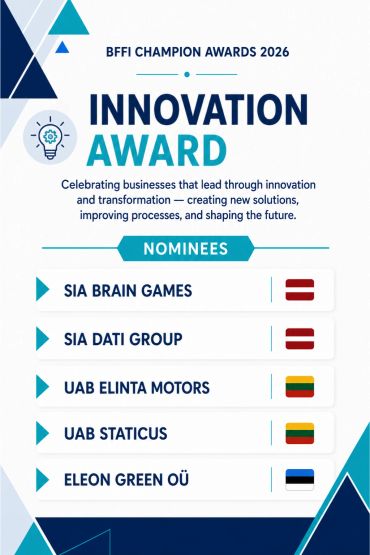
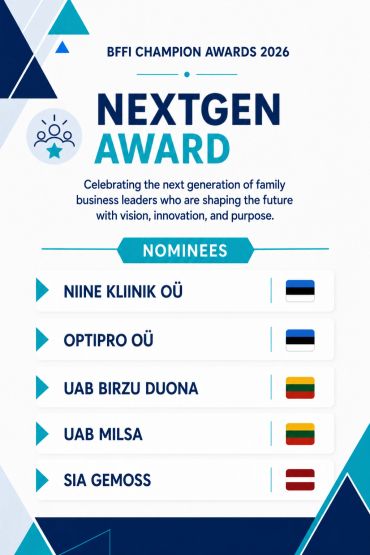
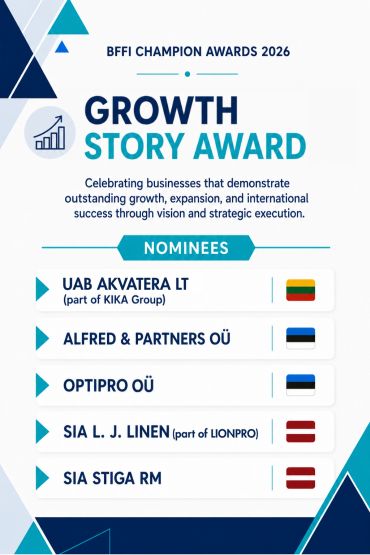
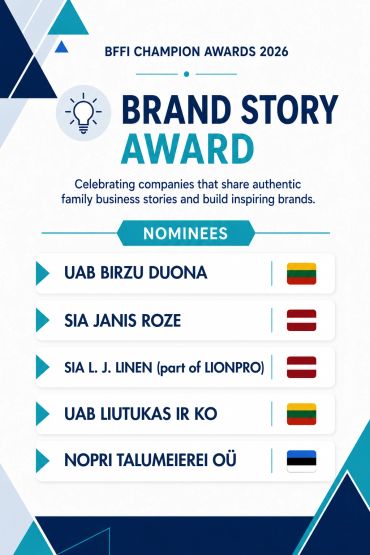
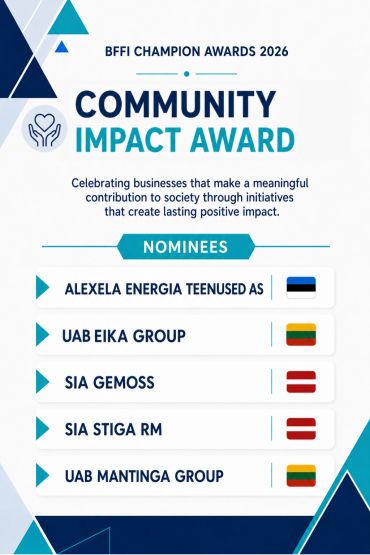
This year, the awards were presented in five categories: Innovation & Transformation, Brand & Storytelling, Community Impact, Growth Story, and Next Generation Leadership. One winner was selected in each category, while all five nominees were recognised. In total, there are 20 companies from all three Baltic countries.
Nominees of the BFFI Champion Awards 2026
Winners of the BFFI Champion Awards 2026
Growth Story – SIA L. J. LINEN, part of the LIONPRO group
Growth Story – SIA L. J. LINEN, part of the LIONPRO group
Growth Story – SIA L. J. LINEN, part of the LIONPRO group

As a second-generation family-owned business with more than 30 years of experience, LIONPRO has grown from a regional enterprise into a trusted global partner in animal feed, pet food, and aquaculture ingredients. Built on a foundation of reliability, precision, and fairness, the company has successfully expanded its international reach while staying true to its family values.
Their journey demonstrates how sustainable growth is achieved through long-term thinking, trusted partnerships, and an unwavering commitment to quality. LIONPRO’s success story is an inspiring example of how family businesses can scale internationally while preserving the values that define them.
Innovation & Transformation – Staticus GROUP UAB
Growth Story – SIA L. J. LINEN, part of the LIONPRO group
Growth Story – SIA L. J. LINEN, part of the LIONPRO group
Over the past two decades, Staticus has established itself as a trusted partner in delivering complex façade solutions for some of the most ambitious construction projects worldwide. Through continuous investment in research and development, advanced technologies, and process innovation, the company consistently pushes the boundaries of what is possible in modern construction.
Innovation at Staticus goes hand in hand with sustainability. By integrating life-cycle thinking into product design, production, logistics, and maintenance, the company demonstrates how transformation can create lasting value for clients, partners, and society alike.
Community Impact – SIA STIGA RM
Growth Story – SIA L. J. LINEN, part of the LIONPRO group
Community Impact – SIA STIGA RM
As one of Latvia’s leading wood industry groups, STIGA RM has built its success on sustainable forestry, innovation, and long-term investment in people and communities. Bringing together six companies under one family-owned brand, the group continues to modernize its operations while creating quality jobs and supporting regional development.
What truly sets STIGA RM apart is its commitment to giving back. As proud supporters of cultural, sports, and charitable initiatives, they consistently invest part of their success into strengthening society and contributing to Latvia’s future.
Brand & Storytelling – UAB BIRŽŲ DUONA
Next Generation Leadership – OPTIPRO OÜ
Community Impact – SIA STIGA RM
For more than 70 years, Biržų Duona has been preserving the rich traditions of bread baking while continuously evolving to meet the needs of modern consumers. Rooted in the values of family, craftsmanship, and authenticity, the company has built a brand that successfully connects heritage with innovation.
Since becoming a family-owned business in 2001, Biržų Duona has demonstrated how a strong story, consistent values, and dedication to quality can create lasting trust across generations. Their journey is a powerful example of how family businesses can honour tradition while building a distinctive and award-winning brand.
Next Generation Leadership – OPTIPRO OÜ
Next Generation Leadership – OPTIPRO OÜ
Next Generation Leadership – OPTIPRO OÜ
What makes OptiPro particularly inspiring is its ability to combine generational continuity with professional excellence. Under the leadership of the CEO - an optometrist by training and an active board member of the Estonian Optometrists Society - the company continues to strengthen its expertise while remaining true to its founding values. At the same time, the management board brings together representatives of the first and second generations, reflecting a strong commitment to collaboration across generations. Through continuous investment in specialist knowledge, innovation, and personalized customer care, OptiPro continues to evolve while staying true to its founding mission: helping people see the world more clearly.
The successful engagement of the next generation is one of the defining challenges and opportunities for family businesses. OptiPro exemplifies how thoughtful leadership transition, combined with the active involvement of multiple generations, can strengthen a company’s future while preserving the values that have shaped its journey.
Distinguished Family Business of the Year 2026: Family Business in the Capital Market
LTD BANGA